
Interaction Design + Experience Design
Redesigning an everyday ritual for connection.

Experience at work
Who's At Your Table?
Who’s At Your Table? is a dinner-based interaction system that helps queer chosen families practice conversations around care, boundaries, support, health, and the future. Through prompts, shared practices, physical gestures, and objects placed around the table, the experience turns a familiar meal into a structure for making care more visible, discussable, and actionable.
Role
Interaction Designer
Organization
Independent
Timeline
August 2025 - Present
Methods
Interaction Design
UX Research
Experience Design
Collaborators
Sole Designer
My Contribution
UX Research
Experience Design
Physical Fabrication
01 / THE SITUATION
Care can be deeply felt without ever being discussed.
Chosen family became essential in my own life during a period when support from my biological family became uncertain. But even within relationships built through care, conversations about needs, boundaries, health, aging, and responsibility could still be difficult to initiate.
For many queer people, chosen family can become part of the support system biological family may not provide.

Initial Concept
THE QUESTION
How might interaction design help chosen families practice conversations about care before a crisis makes them necessary?
Chosen family can carry real responsibilities around care, health, support, and the future, but we do not always have the tools or language to talk about them clearly. These expectations can remain unspoken until moments of stress or crisis make them harder to navigate. Conversations on surrogacy. Your medical proxy in a time of need. And so much more are complicated in queer relationships
02 / DISCOVERY
Research changed who I was designing for.
Originally, I began by asking how design might help queer people repair strained relationships with biological family. But research complicated that premise. “Repair” can imply returning a relationship to what it once was, even when that past was harmful.
I became more interested in restoration: creating conditions for relationships to become something new. That shifted my attention toward relationships queer people were already building through care: chosen family.


Workshops on unpacking queer rituals

Design Principles
Co-designed conditions for conversation


03 / AN EARLY DIRECTION
What if technology could help deepen the conversation?
One early concept used spatial computing and AI to listen for conversational patterns and surface moments that might be worth exploring further.
The system would use projection and transcription-based cues to identify when a conversation might benefit from a deeper prompt.
Design Hypothesis
Tables are already sites of connection. What if the table itself became the interface?

Initial Concept
04 / THE PIVOT
What if technology could help deepen the conversation?
My co-designers pushed back. Being recorded made vulnerable conversation feel surveilled rather than supported.
Key Insight
Conversations about care sometimes require less technology, not more.
The interaction needed to support vulnerability without interpreting, recording, or mediating what participants said.


Prototyping Workshop 1
So I removed it.
Instead of asking technology to interpret the conversation, I leaned into what makes conversation rich: the physical connection. I designed physical prompts, shared practices, gestures, pacing, food, and objects that let participants guide it themselves.
05/ THE INTERACTION
I turned the conversation into an experience people could move through together.
Rather than designing another digital interface for people to talk through, I treated the table itself as an interface. Its shape, objects, prompts, sequence, and familiar rituals of sharing food became the interaction system.

Material Ingredients
The components of the experience were all tactile and tangible forms that supported conversation


Experience Guide
Anatomy of the Interaction
Practice Pieces
Shared agreements the group chooses before the conversation begins.


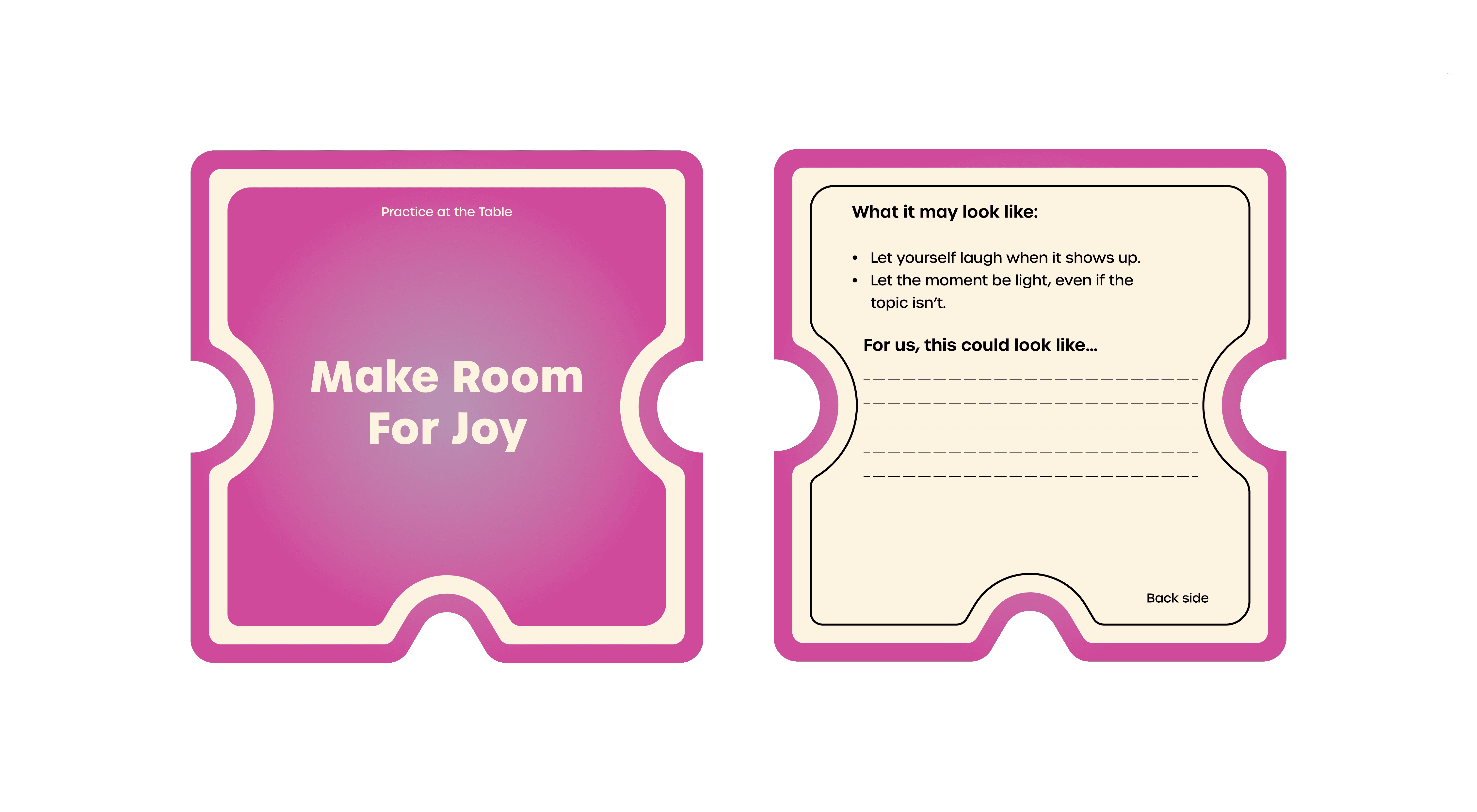

Prompt Cards
Served on custom Appetizer and Entree plates, progressing from lighter entry points into conversations about care, boundaries, health, and the future to deeper more vulnerable prompts

Carry Forward
A closing reflection that turns conversation into something participants can revisit after leaving the table.


06 / A MOMENT AT THE TABLE
"We already consider each other friends, but wow....We came out understanding parts of us that I didn't even realize."
- Table Participant (06/25/2026)


The structure gave participants room to explore conversations they did not necessarily know they were waiting to have.
Watch the project film ↗
07/ INTERACTION BEYOND THE DIGITAL
Relational Design is Care Work
This project changed how I understand interaction design. The interface did not need to be a screen. It could be a table, a ceramic plate, a question, a gesture, or the decision to pass food to someone sitting beside you.
WHAT HAPPENED
The ritual moved beyond the thesis exhibition.
The overwhelming number of participant responses, feedback, and reactions showed that this experience wasn't only built for academia but also had space beyond it.
WHAT I LEARNED
Care needs structures for becoming speakable.
Design can create space for supporting connection and relationships. Relational design has so much potential, especially in areas where care is present but needs support. Something as complex and vulnerable as future-making and understanding becomes easier through a designed experience that helps conversation transpire and makes actionable inputs visible.
WHAT I’M CARRYING FORWARD
Interaction design can shape relationships, not only interfaces.
Who's At Your Table continues to operate outside of the walls of SVA. This current chapter explores portability, hosted gatherings, and community partnerships that allows this experience to travel while mantaining it's intentionality.


